Last updated 2026-08-18
TL;DR
Texas regulates yellow grease collection and rendering under the Texas Agriculture Code, Chapter 142, administered by the Texas Department of Agriculture. Collectors, transporters, and renderers must register with TDA before operating. Registration fees vary by business type; confirm current amounts with TDA. Stealing grease from a registered container is a criminal offense under the same chapter.
Do you need a license for yellow grease in Texas?
Yes. Texas Agriculture Code Chapter 142 requires anyone who collects, transports, processes, or renders used cooking oil (the statute calls it "inedible kitchen grease") to hold a valid registration from the Texas Department of Agriculture [1]. That registration is not optional. Operate without it and you expose yourself to civil penalties and, depending on what you did, criminal charges.
The law covers the whole chain. A restaurant selling its own grease to a licensed renderer is fine. But the collector who picks it up, the transporter who hauls it, and the renderer who processes it each need their own registration [1]. Run more than one of those roles under one entity and you generally need the right registration for each function. Confirm the exact categories with TDA at (800) 835-5832 or through the TDA licensing portal.
Stealing inedible kitchen grease is its own offense under Chapter 142. The statute treats unauthorized removal from a registered container as theft, and penalties climb with volume and value [1]. That language exists because grease theft got bad enough in Texas to earn its own statute, separate from general theft law.
What does the Texas Department of Agriculture actually regulate?
TDA's authority here comes from Texas Agriculture Code Chapter 142, which the legislature wrote to manage the inedible kitchen grease stream [1]. The chapter defines "inedible kitchen grease" as grease from food preparation that is not fit for human consumption, and it pulls that definition inside TDA's licensing framework.
TDA issues registrations to three groups. Collectors pick up used cooking oil from restaurants and food processors. Renderers process collected grease into commodities like biodiesel feedstock or animal feed ingredients. Transporters move grease between the two. Brokers who arrange deals without ever taking physical possession sit in a gray area, so call TDA directly to pin down your specific model.
Enforcement runs through inspections of vehicles and containers, records audits, and coordination with local police on theft cases. TDA publishes a list of currently registered collectors and renderers, and restaurants use it to check who they're handing grease to. That list has real operational weight: a restaurant that hands grease to an unregistered collector can face scrutiny under the same statute [1].
Curious how other states run this? California uses a similar mandatory registration scheme through CDFA. See our writeup on the yellow grease board in California.
How much does yellow grease cost in Texas?
Two cost questions matter here. What you pay the state for registration, and what the commodity itself trades for. They are not the same, and people mix them up constantly.
TDA sets tiered registration fees by business type and scale [1]. Confirm current amounts with TDA before you budget, because fee schedules shift with legislative sessions and agency rule updates. I won't print a dollar figure here that goes stale in a year; the TDA licensing portal has the live number.
On commodity price, yellow grease (traded as used cooking oil or UCO) has a published market. USDA's Agricultural Marketing Service tracks yellow grease prices in its weekly reports [2]. USDA AMS data shows yellow grease running roughly $0.20 to $0.55 per pound at various points over the past few years, with heavy swings driven by biodiesel policy and competing feedstock demand [2]. That range is real but wide. Your actual net per gallon rides on your local buyer, your collection volume, and your transportation costs.
Texas is big enough that price varies by region. A Houston-area collector sitting near Gulf Coast biodiesel plants usually sees different posted prices than someone in the Panhandle. Nobody has clean Texas-specific data on this; the closest consistent source is the USDA AMS weekly livestock and grain reports, which aggregate by broader region [2].
Startup costs beyond registration include insulated storage containers, a collection vehicle, liability insurance, and the paper kit that proves your registration and chain of custody on every pickup. YellowGreasePath's Bin + Theft + Renderer Kit ($149 one-time) covers those documents; details are at /start. You can also assemble the same documents yourself from TDA forms and basic contracts.
How long does yellow grease licensing take in Texas?
TDA doesn't publish a guaranteed processing time for inedible kitchen grease registrations, so any exact number I gave you would be a guess. Processing depends on application volume, how complete your submission is, and staffing. The honest answer: apply early, apply complete.
What slows applications is almost always missing paperwork. TDA wants a complete application, the applicable fees, and in some cases proof of insurance or a bond [1]. Submit with a gap and it bounces back to you, and the clock restarts. Check the current application checklist on TDA's website before you send anything.
People in the industry describe the Texas process as fairly straightforward next to states with longer queues, but that's anecdote, not a promise. Plan for four to eight weeks as a working assumption and build that buffer into your launch. Confirm with TDA when you apply.
What are the Texas container and labeling rules for yellow grease?
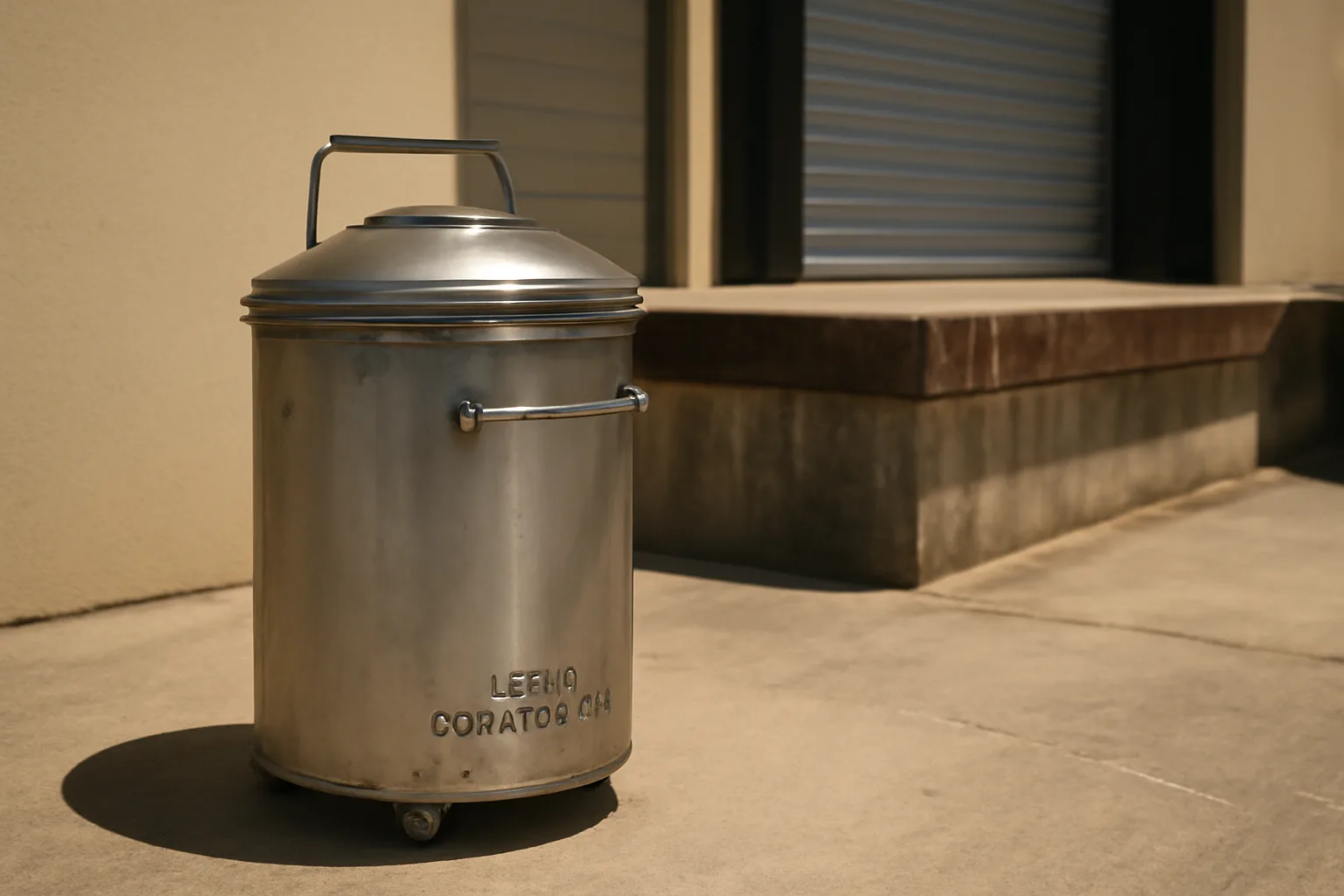
Chapter 142 and TDA's rules set container standards for inedible kitchen grease. Containers must be clearly marked with the registered collector's information, and they must meet leak-proof and sanitation standards [1]. The marking isn't cosmetic. It's what establishes legal ownership of the grease against a theft claim.
This matters more than it sounds. If a competitor pulls grease from a container properly marked with your registration, that's exactly the conduct the statute criminalizes [1]. Mark it wrong or not at all, and your position in a theft dispute gets weak fast.
TDA's rules also cover record-keeping. Collectors generally have to keep pickup logs with the source name and address, the volume collected, and the date. Those records have to be available for inspection. The retention period and exact format live in 4 Texas Administrative Code, Chapter 36 [6]; confirm the current version with TDA, because rules get amended between sessions.
Who actually enforces yellow grease rules in Texas and what are the penalties?
TDA is the primary regulator, but enforcement is genuinely multi-agency. TDA inspectors handle administrative violations. Local law enforcement handles the criminal theft provisions. The Texas Department of Public Safety can get involved in vehicle inspections for transportation compliance.
Administrative penalties under Chapter 142 reach up to $10,000 per violation per day for willful or knowing violations [1]. Criminal theft charges under the grease theft provision follow standard Texas theft grading: the value of the grease taken determines whether it's a misdemeanor or a felony. Texas Penal Code Section 31.03 sets those thresholds, and they track the broader Texas theft ladder [3].
Here's the practical picture. TDA points inspection resources at registered entities and at complaints from restaurants about unauthorized collectors. Operate without registration and get reported by a restaurant, and you should expect a follow-up. The agency doesn't have unlimited inspection capacity, but with a $10,000-per-day ceiling, the risk-adjusted cost of skipping registration is high.
How does Texas compare to neighboring states on yellow grease regulation?
Texas sits on the stricter end for documentation among its neighbors, but it isn't the strictest state in the country.
| State | Dedicated used cooking oil statute | Grease theft as specific offense | Agency |
|---|---|---|---|
| Texas | Yes (Ag Code Ch. 142) | Yes | Texas Dept. of Agriculture |
| Oklahoma | No dedicated statute (general theft law applies) | No | N/A |
| Louisiana | Limited registration requirements | Partial | Dept. of Ag & Forestry |
| Arkansas | Grease collection regulated | No specific theft offense | Arkansas Dept. of Ag |
| New Mexico | No dedicated statute | No | N/A |
This table reflects the general regulatory posture as of 2025; confirm current rules in each state with the relevant agency before you operate across state lines. Arkansas runs its own registration framework, and our article on the yellow grease board in Arkansas covers what applies there.
Thinking about expanding? The lighter setup in Oklahoma and New Mexico doesn't mean those markets are unregulated. General commercial law, UCC Article 2, and local environmental rules fill the space instead. That's a different compliance posture, not an easier one across the board.
What insurance do yellow grease collectors and renderers need in Texas?
Texas doesn't mandate a specific insurance product through Chapter 142 the way some states do, but you need several kinds of coverage before you can operate without real risk.
Commercial auto insurance is required by Texas law for any vehicle used in commerce [4]. Collection vehicles hauling liquid cargo need cargo coverage specifically, because a standard commercial auto policy often excludes liquid cargo spillage. Read your policy language carefully.
General commercial liability protects you when a container damages a restaurant's property or a spill hits a pickup site. Renderers turning oil into fuel products may also need product liability coverage.
If TDA requires a surety bond as part of your registration (confirm this with TDA directly, since bond rules change), that bond is not insurance. It's a financial guarantee that you'll comply with the rules. Bond amounts and insurers sit separate from your liability policy.
Texas has a competitive commercial insurance market. Get quotes from brokers who actually work with food waste or liquid waste haulers. Rates swing hard by vehicle type, coverage limits, and your loss history.
What records do you need to keep for yellow grease operations in Texas?
TDA requires registered collectors and renderers to keep records that document the chain of custody for every load of inedible kitchen grease [1]. The exact rules live in 4 Texas Administrative Code, Chapter 36 [6]; pull the current version from the Texas Secretary of State's Texas Register or the TDA website rather than trusting any summary, including this one.
Log these items on every pickup: the date, the source's name and physical address, the volume collected (by weight or gallon, depending on your reporting basis), your vehicle or equipment ID, and the destination renderer or processor. A signed receipt from the source restaurant isn't legally required in every case, but it's strong evidence in a dispute and a good habit.
Digital records are fine. A simple route log in a spreadsheet works. What TDA wants is proof that you can account for every load you picked up and where it went. Gaps in that chain create audit problems.
Tight records pay off beyond compliance. If grease gets stolen from a container you service, your pickup log establishes volume, timing, and value, which matters for both a theft report and any civil recovery.
How do you find buyers and renderers for yellow grease in Texas?
Texas has serious rendering and biodiesel infrastructure, especially along the I-10 and I-35 corridors and around Houston, given the energy and petrochemical concentration there. Finding buyers is easier than you'd think. The hard part is usually price negotiation and volume commitments.
Start with TDA's published list of registered renderers in Texas. It's public, and it's the most reliable place to begin because every entity on it is legally registered to receive grease from you [1]. Cold-calling registered renderers beats trusting broker directories of uncertain quality.
Biodiesel producers are a second buyer category. Clean Fuels Alliance America (formerly the National Biodiesel Board) tracks member facilities by state; that list isn't exhaustive but it's a solid starting point [5].
Long-term supply agreements are common in this trade. A renderer will often provide containers and sometimes cover collection costs in exchange for a volume commitment. That cuts your upfront capital but ties you to one buyer's pricing. Negotiate a price adjustment mechanism tied to a published index like USDA AMS yellow grease prices [2].
Newer to the state? Reading how nearby markets work can set your expectations. The yellow grease board in Florida covers a high-volume market with similar commodity dynamics.
What should you do before your first yellow grease pickup in Texas?
Get your TDA registration in hand before you touch anyone's container. Non-negotiable.
After registration, confirm your commercial auto and cargo insurance is active and covers liquid food waste. Mark every container you place with your registered business name and TDA registration number per Chapter 142 [1]. Have your pickup log system ready, paper or software. Know the name and address of the renderer or processor you're delivering to on day one.
Brief your restaurant clients too. The owner or manager should know your registration status. TDA's registered collector list is public, and the sharper restaurant operators check it. Being on that list protects both of you.
YellowGreasePath's Bin + Theft + Renderer Kit at /start gives you container labeling templates, chain-of-custody paperwork, and renderer agreement starting points as a one-time $149 package. You can build the same documents yourself from TDA guidance; the kit just saves the drafting time.
Looking at multi-state operations? Check the yellow grease board in Arizona and the yellow grease board in Colorado for how nearby western markets handle registration before you cross a state line.
Frequently asked questions
Do you need a license for yellow grease in Texas?
Yes. Texas Agriculture Code Chapter 142 requires collectors, transporters, and renderers of inedible kitchen grease to hold a valid TDA registration before operating. There is no exemption for small operators. Operating without registration exposes you to administrative penalties up to $10,000 per violation per day and potential criminal liability if theft provisions are triggered.
How much does yellow grease cost in Texas?
As a commodity, yellow grease has traded roughly between $0.20 and $0.55 per pound in recent years, per USDA AMS weekly reports, with heavy volatility. Texas registration fees vary by business type; confirm current amounts directly with TDA before budgeting. Your net return per gallon also depends on transportation costs, collection volume, and what your specific renderer or biodiesel buyer is posting.
How long does yellow grease licensing take in Texas?
TDA does not publish a guaranteed processing window. As a working assumption, plan four to eight weeks from a complete, correctly documented application. Incomplete submissions restart the clock. Apply early, check the current TDA application checklist before submitting, and follow up with TDA if you haven't received a status update after three weeks.
Is it illegal to steal yellow grease in Texas?
Yes. Texas Agriculture Code Chapter 142 specifically criminalizes unauthorized removal of inedible kitchen grease from a registered container. The criminal grading follows the value of the grease taken under Texas Penal Code Section 31.03, meaning large thefts can reach felony level. Proper container marking with your TDA registration information is the key to establishing legal ownership.
What agency handles yellow grease registration in Texas?
The Texas Department of Agriculture administers inedible kitchen grease registration under Chapter 142 of the Texas Agriculture Code. Contact TDA's licensing division at (800) 835-5832 or through the TDA licensing portal for current applications, fee schedules, and the registered collector and renderer list.
Do restaurants in Texas need to register for yellow grease?
Restaurants that generate used cooking oil and sell or give it to a registered collector generally do not need their own TDA registration. The obligation falls on the collector. But handing grease to an unregistered collector creates liability exposure for the restaurant under Chapter 142, so verifying your collector's registration status is in the restaurant's interest.
What records do Texas yellow grease collectors have to keep?
TDA requires chain-of-custody records for every load: date, source name and address, volume collected, vehicle or equipment ID, and destination renderer. The exact requirements are in 4 Texas Administrative Code, Chapter 36. Pull the current version from the Texas Secretary of State's Texas Register. Digital records are accepted; gaps in the chain create audit exposure.
Can I collect yellow grease in Texas without a physical location?
You need a registered business entity and must meet TDA's application requirements, which include contact information and likely a business address for correspondence. Whether you need a physical processing facility depends on your registration category. Collectors who only transport and do not render may have lighter facility requirements than renderers. Confirm the specific requirements for your intended role with TDA.
What's the penalty for operating a yellow grease business in Texas without registration?
Administrative penalties under Texas Agriculture Code Chapter 142 can reach $10,000 per violation per day for willful or knowing violations. Criminal exposure depends on specific conduct. TDA has authority to issue cease-and-desist orders and refer cases to law enforcement. The penalty ceiling is high enough that the cost of registration is trivial by comparison.
Does Texas have a specific rule about yellow grease container markings?
Yes. Chapter 142 and TDA's implementing rules require containers holding inedible kitchen grease to be clearly marked with the registered collector's name and registration information. Proper marking establishes legal ownership and is the statutory basis for prosecuting theft. Unmarked containers put you in a weaker position if your grease is stolen or disputed.
How do I find registered yellow grease renderers in Texas?
TDA publishes a list of currently registered renderers and collectors, available through the TDA website. It's the most reliable starting point because every entity on it has met TDA's registration requirements. Biodiesel producers are a second buyer category; Clean Fuels Alliance America tracks member facilities by state, which gives you additional leads.
Do I need a separate registration for each Texas county I operate in?
No. TDA registration is a state-level registration, not county-by-county. One valid TDA registration covers statewide collection activity. Local municipal regulations, zoning, or vehicle permit requirements could apply depending on the city or county; check with local authorities in each major operating area, especially for large metro areas like Houston, Dallas, or San Antonio.
Is yellow grease regulated differently from brown grease in Texas?
Texas Agriculture Code Chapter 142 uses the term 'inedible kitchen grease' broadly, which covers both yellow grease (rendered from cooking oil) and brown grease (grease trap waste). But the regulatory handling, disposal requirements, and buyer markets for trap grease differ significantly from used cooking oil. Confirm with TDA which registration categories apply to the specific material you're handling.
Can I cross state lines with yellow grease from Texas without additional permits?
Interstate transport of used cooking oil may trigger USDA and state agricultural inspection requirements in your destination state, on top of your Texas TDA registration. Each state has its own rules. If you're hauling into Arkansas, check our article on the yellow grease board in Arkansas for what applies there. Interstate commerce in animal feed ingredients also has USDA oversight; confirm with USDA APHIS for your specific load type.
Sources
- Texas Legislature, Texas Agriculture Code Chapter 142 (Inedible Kitchen Grease): Texas Agriculture Code Chapter 142 requires registration of collectors, transporters, and renderers of inedible kitchen grease with TDA; establishes container marking and record-keeping requirements; and criminalizes unauthorized removal of grease from registered containers.
- USDA Agricultural Marketing Service, Weekly Livestock, Poultry, and Grain Market News (Yellow Grease Prices): USDA AMS weekly reports track yellow grease commodity prices by region; historical ranges have run approximately $0.20 to $0.55 per pound depending on market conditions.
- Texas Legislature, Texas Penal Code Section 31.03 (Theft): Texas Penal Code Section 31.03 sets theft grading thresholds (misdemeanor to felony) based on value of property taken, which applies to criminal grease theft charges under Chapter 142.
- Texas Department of Motor Vehicles, Motor Carrier Division: Texas law requires commercial auto insurance for vehicles used in commerce; cargo coverage for liquid materials is a separate policy consideration.
- Clean Fuels Alliance America (formerly National Biodiesel Board), Member Facilities Directory: Clean Fuels Alliance America tracks biodiesel producer members by state, providing a starting point for identifying potential yellow grease buyers in Texas.
- Texas Secretary of State, Texas Administrative Code Title 4 Chapter 36 (TDA Inedible Kitchen Grease Rules): 4 Texas Administrative Code Chapter 36 contains TDA's implementing rules for inedible kitchen grease registration, record-keeping requirements, and container standards.
- Texas Department of Agriculture, Licensing and Certification: TDA administers licensing and permitting for regulated agricultural commodities including inedible kitchen grease under its regulatory programs authority.