Last updated 2026-08-18
TL;DR
Utah has no single yellow grease collector license. You will need a Utah business entity, commercial vehicle registration for your pump truck, likely a USDOT number, and county health or environmental permits depending on where you operate. Plan for 4 to 10 weeks to get fully papered up. Grease trades between roughly $0.15 and $0.45 per pound at Utah renderers.
What is yellow grease and why is Utah worth entering?
Yellow grease is used cooking oil pulled from restaurants, food-service operations, and institutional kitchens. Renderers buy it and turn it into biodiesel feedstock, animal feed ingredients, or oleochemical inputs. The market is real and it has been growing. U.S. biodiesel production consumed roughly 3.1 billion pounds of used cooking oil in 2022 according to the U.S. Energy Information Administration [1].
Utah is smaller than California or Texas. That works in your favor. Fewer established collector routes mean restaurants in Salt Lake County, Utah County, and Weber County are sometimes underserved, especially off the Wasatch Front. The grease doesn't disappear just because a big national player hasn't locked it up yet.
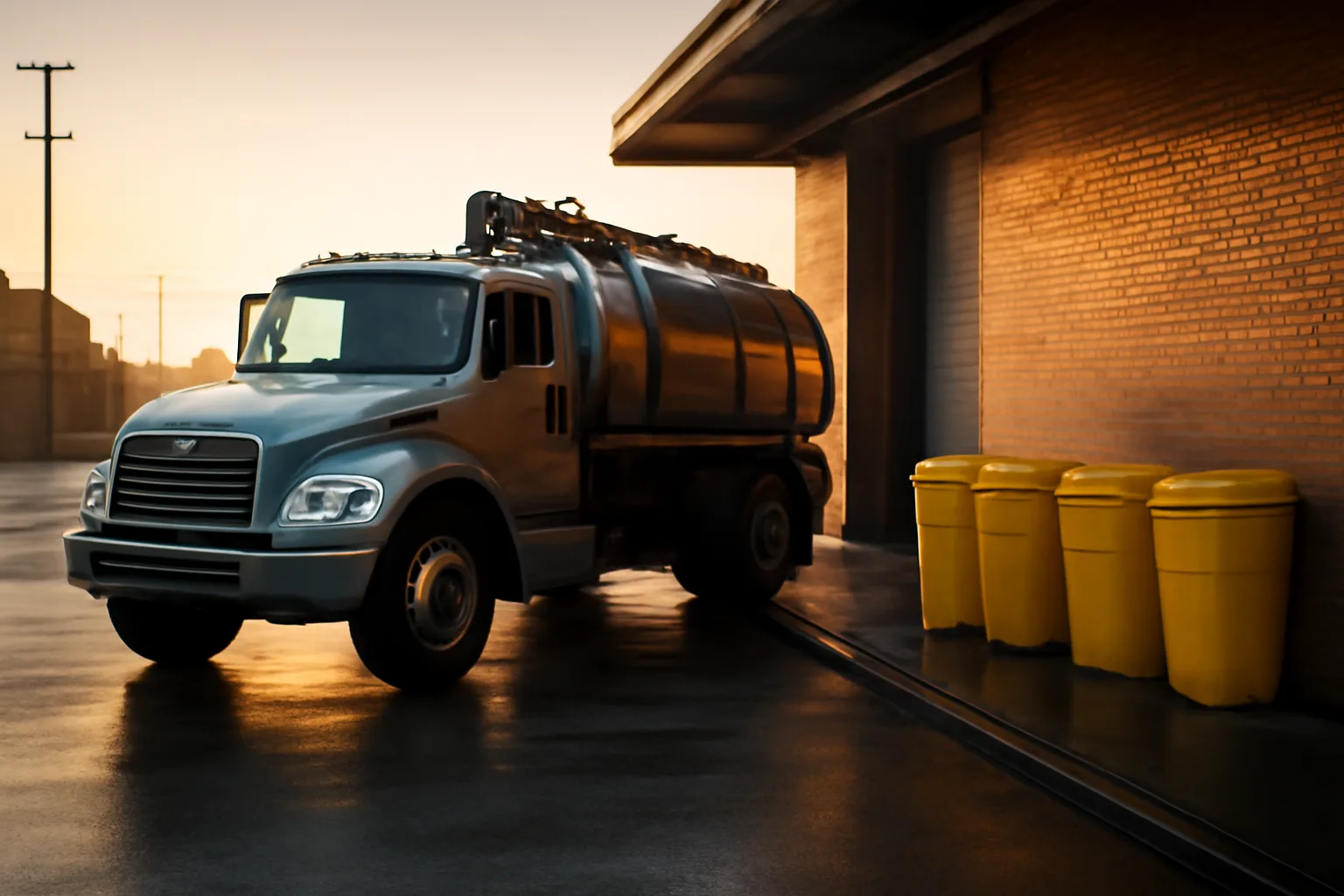
The model is the same one that works everywhere. You place a bin at a restaurant, collect the oil on a schedule, haul it to a renderer, and get paid by the pound or gallon. Some operators run one truck as a side thing. Others build fleets and hire drivers. Neither path needs a specialized yellow grease license at the Utah state level. Both need several overlapping registrations, and skipping any one of them creates real liability.
Do you need a license for yellow grease in Utah?
Utah does not issue a "yellow grease collector license." That is the honest answer. But you can't just buy a pump truck and start collecting.
Here is what you actually need at the state level:
Utah business entity registration. You need a registered entity with the Utah Division of Corporations and Commercial Code. An LLC is the common choice for small operators. The filing fee for a domestic LLC is $70 online per the Division's fee schedule [2]. Confirm the current fee directly with the Division.
Utah sales tax license (if you sell to end buyers). If you sell processed or semi-processed grease rather than hauling under contract for a renderer, the Utah State Tax Commission requires a sales tax license. It costs nothing to get [3].
Commercial vehicle registration and DOT number. Any vehicle with a gross vehicle weight rating over 10,001 pounds operating in interstate commerce needs a USDOT number through the Federal Motor Carrier Safety Administration [4]. Run only inside Utah and the thresholds shift, but commercial registration through the Utah Motor Vehicle Division still applies. A loaded pump truck usually sits well above 10,001 pounds.
County or municipal business license. Salt Lake County, Utah County, Davis County, and most incorporated cities require a local business license. Fees typically run $50 to $200 per year. Confirm with your specific county.
Health or environmental permits. Some Utah counties treat used cooking oil handling as a solid waste or food-related activity that needs a permit through the local health department. The Salt Lake County Health Department and the Utah Division of Environmental Quality are your first two calls. There is no single statewide permit, so check at the county level for your operating area.
The paper stack is real. It just isn't concentrated in one license.
How much does yellow grease cost in Utah? What can you earn per pound?
"Cost" here is two numbers. What you pay to operate (fuel, equipment, insurance, time) and what price you receive from the renderer.
Renderer prices for used cooking oil move with commodity markets. In 2023 and into 2024, prices ranged nationally from roughly $0.30 to $0.55 per pound during biodiesel demand spikes and dropped toward $0.10 to $0.20 per pound in softer stretches [5]. Utah prices track national markets with a regional discount, because fewer processors compete for the oil and transportation to larger facilities eats into the number. Expect $0.15 to $0.45 per pound as a realistic Utah range, and confirm the current figure with the renderer before you sign anything. These numbers move.
The table below gives a rough first-year cost picture for a single-truck operation. These are illustrative ranges built from published equipment costs, Utah DMV fee schedules, and standard insurance quotes. None are guarantees.
| Cost Item | Estimated Annual Range |
|---|---|
| Used pump truck (purchase, not lease) | $8,000 to $25,000 |
| Commercial auto insurance | $3,000 to $7,000/yr |
| General liability insurance | $1,000 to $2,500/yr |
| Utah LLC registration (year one) | $70 (plus $15 annual renewal) |
| Local business licenses | $50 to $400/yr |
| Fuel (depends on route density) | $6,000 to $18,000/yr |
| Grease storage tank or IBC totes | $500 to $3,000 |
| Pump and hose equipment | $1,500 to $6,000 |
A realistic first-year all-in cost for a lean single-truck operation runs somewhere in the $20,000 to $55,000 range before collections revenue. A route that reliably pulls 5,000 to 10,000 pounds of oil per month at $0.25 per pound generates $1,250 to $2,500 monthly from the renderer. Volume and price are everything. The operators who make this work early lock in restaurant agreements before buying equipment, not after.
How long does yellow grease take in Utah? What's the timeline from idea to first pickup?
Plan for 4 to 10 weeks from first paperwork to your first legal collection run. Here is why that range is wide.
Utah LLC registration processed online through the Division of Corporations typically completes in 1 to 3 business days for standard filings [2]. That is the fast part.
A USDOT number through the FMCSA takes a few days to a couple of weeks depending on whether your application triggers a review [4]. Running intrastate only, you may not need full operating authority, but you still need DOT registration if you cross the 10,001-pound threshold.
Commercial vehicle registration at the Utah DMV depends on whether you already own the truck or are buying one. Apportioned plates (if you might cross state lines) add time and involve the Utah International Registration Plan desk [6]. Budget 2 to 4 weeks for the vehicle paperwork.
Local business licenses and county environmental permits are the wild card. Some Utah cities issue them over the counter in a day. Others schedule inspections, require a site visit to your storage location, or run a 4 to 6 week review cycle. Call your specific county or city clerk before you count on a short timeline.
Insurance binds quickly once you have a commercial auto quote and the carrier has your DOT number. That usually takes 1 to 5 business days.
The fastest realistic path to fully legal is about 4 weeks if everything goes cleanly. More typical is 6 to 8 weeks. Don't sign restaurant collection contracts with start dates you can't legally meet.
What equipment do you actually need to collect yellow grease in Utah?
The minimum viable rig is a service truck with a grease pump and a storage tank. That's it. People over-engineer the entry point.
Utah terrain matters. Work routes south toward St. George or east into rural areas and your truck needs to handle elevation and temperature swings. Grease thickens in cold weather, which makes pump-outs slower in Utah winters. A heated tank or insulated IBC totes help during January and February in northern Utah, where temperatures regularly drop below 20 degrees Fahrenheit.
Standard equipment list for a starting Utah operator:
- Used pump truck with at least a 500-gallon tank (1,000 gallons is better if your routes are dense)
- A diaphragm or gear pump that can move viscous used oil
- Food-grade hose rated for cooking oil, minimum 1.5-inch diameter
- Locking collection bins for restaurants (standard sizes are 55-gallon drums or 35-gallon specialty bins)
- Spill kit (any petroleum or oil transport calls for one; Utah's Solid and Hazardous Waste Division and USDOT both expect spill preparedness)
- Logbook or route management software to track pickups and weights
Buy used. The restaurant equipment and food service industry generates plenty of used IBC totes and pump gear. Sanitary condition matters to your renderer. The age of your tank does not.
For operators building a documentation and agreement system from scratch, YellowGreasePath sells a bin placement, theft deterrence, and renderer agreement kit for a one-time $149 at /start. That covers the paper side, not the truck.
How do you find Utah renderers to sell your grease to?
Most new operators skip this step until it's too late. You need a committed buyer before you commit to collection agreements. Don't collect oil you have nowhere to deliver.
Utah has a limited number of in-state rendering or processing facilities compared to Iowa or California. Your realistic options:
In-state renderers. A small number of rendering operations sit along the Wasatch Front. The National Renderers Association publishes a member directory listing facilities by state [7]. Call facilities directly. Prices and acceptance criteria vary, and some require minimum volumes before they take a new supplier seriously.
Out-of-state transport. Some Utah operators truck oil to processors in Nevada, Idaho, or Colorado. That raises transport cost and requires interstate operating authority if your commercial vehicle is over 10,001 pounds GVWR. It can still pencil out at a better price, but confirm your DOT authority covers interstate hauls before you cross state lines.
Biodiesel producers. A few producers in the Mountain West buy used cooking oil directly. This sometimes beats rendering on price, but volumes and quality specs are stricter.
Call at least three buyers before you sign a single restaurant agreement. Ask each one: What price are you paying today? What quality standards do you require (water content, free fatty acid percentage)? What is your minimum accepted volume per delivery? What is your payment timeline?
The price you get from a renderer is probably the biggest variable in whether this business works for you in year one.
How do you get restaurants in Utah to give you their used oil?
Restaurant grease agreements are usually verbal or a simple one-page contract. You provide the bin, you show up on schedule, and you handle any mess. In return, you get the oil.
In a paying market, you also pay the restaurant a per-gallon or per-pound rate. Whether Utah is a paying market or a free-collection market right now depends on commodity prices and competition on your routes. During the high-price runs of 2022 and early 2023, restaurants in many cities expected to be paid. In softer markets, free collection is common again. Check current renderer prices and work backward to see what you can afford to offer.
Grease theft is a real problem nationally. The National Restaurant Association has flagged grease theft as an ongoing issue for operators [9]. Your bins should be lockable. Your agreements should state that the oil is your property once placed in the bin. That language matters if you ever chase theft recovery.
For Utah, focus early prospecting on:
- Independent restaurants and fast-casual chains outside downtown Salt Lake City (large national chains often have existing contracts)
- Food trucks and catering operations (they generate oil but get overlooked)
- Institutional kitchens at schools, hospitals, and government facilities (bigger volumes, steadier schedules)
You will hear "no" a lot. That's fine. Route density is what makes this profitable, so you need enough accounts inside a compact geography to make each truck run worth the fuel and time.
Building agreements in neighboring states too? The how to start yellow grease in Colorado and how to start yellow grease in Arizona guides cover the permit differences across those borders.
What insurance does a Utah yellow grease operator actually need?
Commercial auto insurance is required by law for any commercial vehicle in Utah, and by FMCSA regulations for carriers running in interstate commerce [4]. For a single pump truck, premiums typically run $3,000 to $7,000 per year depending on the vehicle's age, your driving history, and your limits. Get quotes from carriers that specialize in commercial fleet or small trucking, not your personal auto insurer.
General liability insurance protects you if a spill at a restaurant causes property damage or a slip-and-fall. Most restaurant operators will ask for a certificate of insurance naming them as additionally insured before they let you place a bin. Budget $1,000 to $2,500 per year for a basic GL policy at $1 million per occurrence.
Hire employees and Utah requires workers' compensation insurance. That runs through the Utah Labor Commission [10]. Single-member LLCs with no employees typically don't need it yet, but plan for it.
Some operators also carry cargo insurance to cover the oil in transit. It is not always legally required, but if you're hauling $800 to $2,000 worth of oil per load, the premium is usually small against the exposure. Confirm with your broker.
One thing worth knowing: Utah does not require a surety bond for grease collectors the way some states require bonds for certain haulers. Confirm this hasn't changed with the Utah Division of Environmental Quality before relying on it.
What are the biggest mistakes new Utah yellow grease operators make?
Buying equipment before confirming a buyer. This is the number one way new operators lose money. A truck and a tank sitting in your driveway while you cold-call renderers is a cash drain. Confirm your buyer first.
Underestimating theft losses. Yellow grease theft is real, not theoretical. The FBI and industry groups have documented organized grease theft operations [9]. Unlocked bins, uncontracted restaurants, and no written agreements make you an easy target. Lock your bins. Put your contact information on them. Use written agreements.
Ignoring water contamination. Renderers reject or heavily discount loads with high water content. Water gets into bins from rain, from staff dumping ice, and from careless handling. Train your restaurant contacts on what goes in the bin. Check loads before you accept them.
Covering too much geography too fast. The Wasatch Front has density, but driving from Ogden to Provo and back in a day with a half-loaded truck loses money. Build tight routes first. Expand only when a route is full.
Skipping the renderer contract. Month-to-month verbal deals leave you exposed to sudden price cuts or a refused delivery. Get your pricing terms in writing, even if it's just a signed email confirmation.
What does the full Utah yellow grease startup checklist look like?
Here is the practical sequence, in order:
1. Confirm at least one renderer will buy your oil. Get a price quote in writing or by email. 2. Register your business entity with the Utah Division of Corporations and Commercial Code ($70 for an LLC, online) [2]. 3. Obtain an EIN from the IRS (free, instant online) if you're operating as an LLC or hiring employees. 4. Apply for a USDOT number through the FMCSA if your vehicle will exceed 10,001 pounds GVWR [4]. 5. Register your commercial vehicle with the Utah DMV. Crossing state lines, apply for apportioned plates through Utah's IRP program [6]. 6. Obtain a Utah sales tax license from the Utah State Tax Commission if you're selling grease to buyers (free) [3]. 7. Apply for your local county or city business license. Check with Salt Lake County, Utah County, or Weber County depending on your primary operating area. 8. Confirm with the county health department and Utah Division of Environmental Quality whether any environmental permit is required for your storage location [12]. 9. Bind commercial auto and general liability insurance. 10. Purchase or fabricate lockable collection bins. 11. Draft a simple one-page collection agreement for restaurant partners. Have a local attorney review it once. 12. Sign your first restaurant accounts. 13. Do your first collection run.
YellowGreasePath's Bin + Theft + Renderer Kit at /start covers steps 10 through 12 in document form, which is a reasonable way to skip reinventing those agreements.
For how neighboring states handle their permit stacks, see how to start yellow grease in Colorado and how to start yellow grease in Arizona.
What Utah state agencies and federal agencies actually regulate this business?
Knowing who to call saves time. Here is the short agency map for a Utah yellow grease operation:
Utah Division of Corporations and Commercial Code handles your business entity registration [2]. It is a division of the Utah Department of Commerce.
Utah State Tax Commission handles your sales tax license and any fuel tax obligations if you use yellow grease as vehicle fuel [3].
Utah Department of Transportation / Utah DMV handles commercial vehicle registration and weight permits [6].
Federal Motor Carrier Safety Administration (FMCSA) handles USDOT numbers and interstate operating authority [4]. It is a federal agency, not a state one.
Utah Division of Environmental Quality (DEQ) is the agency to call about used oil as a waste or commodity. Under EPA rules, used cooking oil managed as a commodity rather than a waste carries different requirements than used motor oil, but DEQ can confirm what state rules apply to your specific storage and transport [12].
Utah Labor Commission handles workers' compensation requirements once you start hiring [10].
Local county health departments in Salt Lake, Utah, Davis, and Weber counties may have added food-related business or waste handling permits. Confirm with each county you operate in.
The EPA's used oil regulations matter here. Under 40 CFR Part 279, used cooking oil that is not mixed with used motor oil and is managed as a commodity is generally not classified as hazardous waste, but the specifics matter [12]. Confirm your handling practices with a local environmental attorney if you're uncertain.
Frequently asked questions
Do you need a license for yellow grease in Utah?
Utah does not have a dedicated yellow grease collector license. You need a registered business entity with the Utah Division of Corporations, commercial vehicle registration and likely a USDOT number, a local business license from your county or city, and possibly a county health or environmental permit depending on your storage location. The paper stack is real even without a single named license.
How much does yellow grease cost to start in Utah?
First-year costs for a single-truck operation run roughly $20,000 to $55,000 depending on whether you buy or already own a truck, insurance costs, and local permit fees. The Utah LLC registration itself is $70 online. Revenue depends on renderer prices, which ran $0.15 to $0.45 per pound in Utah-adjacent markets in recent years. Confirm current prices with your renderer before committing to routes.
How long does it take to start a yellow grease business in Utah?
Plan for 4 to 10 weeks from first paperwork to your first legal pickup. Utah LLC registration online takes 1 to 3 business days. A USDOT number takes a few days to two weeks. Local business licenses and county permits are the wildcard and can take 4 to 6 weeks if an inspection is required. Do not sign restaurant agreements with start dates you can't legally meet.
Do I need a USDOT number to collect yellow grease in Utah?
If your truck has a gross vehicle weight rating over 10,001 pounds and you operate in interstate commerce, a USDOT number through the FMCSA is federally required. If you operate only within Utah, commercial registration still applies but the interstate operating authority requirement may not. Confirm your specific situation with the FMCSA before your first run.
Is used cooking oil considered hazardous waste in Utah?
Used cooking oil that is managed as a commodity and not mixed with used motor oil is generally not classified as hazardous waste under EPA regulations at 40 CFR Part 279. Utah DEQ enforces these federal rules at the state level. That said, storage and spill practices still matter. Confirm your specific handling setup with the Utah Division of Environmental Quality.
Where do I sell yellow grease in Utah?
The National Renderers Association publishes a member directory listing facilities by state. Utah has a limited number of in-state rendering facilities, so some operators truck oil to processors in Nevada, Idaho, or Colorado. Biodiesel producers in the Mountain West region also purchase used cooking oil directly. Confirm buyer pricing, volume minimums, and quality standards before signing restaurant collection agreements.
Can yellow grease be stolen from my bins in Utah?
Yes. Grease theft is documented nationally and is not hypothetical. Use lockable bins, put your business name and contact on every bin, and use written collection agreements that establish your ownership of the oil. Some operators also photograph bin installations and keep pickup logs as evidence in case of theft. The National Restaurant Association has flagged this as an ongoing problem for the industry.
What truck do I need to collect yellow grease in Utah?
Any service truck with a pump and a tank in the 500 to 1,000 gallon range works as a starting rig. For Utah winters in northern areas, a heated tank or insulated IBC totes help because used cooking oil thickens significantly below 40 degrees Fahrenheit. Buy a truck with a GVWR over 10,001 pounds and you'll need a USDOT number and commercial registration. A used truck in the $8,000 to $25,000 range is realistic.
Do I need to pay restaurants for their used cooking oil in Utah?
It depends on current commodity prices and local competition. During high-price periods like 2022 and early 2023, many restaurants expected to be paid. In softer markets, free collection is more common. Check current renderer prices, calculate your operating costs per gallon, and work backward to determine what you can offer. Never promise payment rates you haven't confirmed are sustainable with your buyer's current pricing.
What permits do I need from Salt Lake County to collect yellow grease?
Salt Lake County requires a local business license for commercial operations. Depending on your storage setup, the Salt Lake County Health Department may also require a permit related to food-related waste handling. There is no single combined yellow grease permit. Call the Salt Lake County Business Licensing office and the Salt Lake County Health Department directly to confirm current requirements for your specific operation type.
What's the difference between yellow grease and brown grease?
Yellow grease is used cooking oil collected from fryers and kitchen equipment before it has significantly degraded. Brown grease comes from grease traps and interceptors and has much higher water content, free fatty acid levels, and contamination. Yellow grease commands higher renderer prices. Brown grease handling involves different permits and different buyers. Starting operators should focus on yellow grease collection only.
Do I need workers' compensation insurance for my yellow grease business in Utah?
Utah requires workers' compensation insurance once you hire employees. The Utah Labor Commission administers this requirement. Single-member LLCs with no employees typically do not need it initially, but as soon as you hire a driver or helper, coverage is required. Confirm current rules with the Utah Labor Commission before your first hire.
How do I write a collection agreement with a Utah restaurant?
A basic collection agreement should specify who owns the oil once it's in your bin, your pickup schedule, the bin you're providing, your liability for spills during collection, and the term of the agreement. It doesn't need to be long. Have a Utah-licensed attorney review your template once before you use it broadly. Written agreements also help with theft recovery if someone else takes your collected oil.
Is yellow grease in Utah taxable?
If you sell used cooking oil to a renderer or other buyer, that transaction may be subject to Utah sales tax rules depending on how it is structured. Obtain a sales tax license from the Utah State Tax Commission, which is free. Whether the specific sale is taxable depends on the buyer's use and how you invoice. Confirm with a Utah CPA or the Tax Commission directly before your first sale.
Sources
- U.S. Energy Information Administration, Monthly Biodiesel Production Report: U.S. biodiesel production consumed roughly 3.1 billion pounds of used cooking oil in 2022
- Utah Division of Corporations and Commercial Code, Business Registration Fee Schedule: The filing fee for a domestic LLC in Utah is $70 online
- Utah State Tax Commission, Sales Tax License: A Utah sales tax license is free to obtain
- Federal Motor Carrier Safety Administration, USDOT Number Registration: Vehicles over 10,001 pounds GVWR operating in interstate commerce require a USDOT number
- U.S. Energy Information Administration, Biodiesel Feedstock Data: Used cooking oil prices ranged nationally from roughly $0.10 to $0.55 per pound between 2022 and 2024 depending on market conditions
- Utah Division of Motor Vehicles, International Registration Plan (IRP): Utah operators crossing state lines apply for apportioned plates through the Utah International Registration Plan program
- National Renderers Association, Member Directory: The National Renderers Association publishes a member directory listing rendering facilities by state
- Renewable Fuels Association: The Renewable Fuels Association tracks biofuel producers nationally who may purchase used cooking oil
- National Restaurant Association, Research and Media: Grease theft is documented as an ongoing problem for restaurant operators nationally
- Utah Labor Commission, Workers' Compensation: Utah requires workers' compensation insurance once an operator hires employees
- U.S. EPA, 40 CFR Part 279: Standards for the Management of Used Oil: Used cooking oil managed as a commodity and not mixed with used motor oil is generally not classified as hazardous waste under federal EPA regulations